AQUA Wallet Review: JAN3's Self-Custodial Bitcoin Wallet That Hides the Hard Parts
There's a growing category of Bitcoin wallet that tries to do something genuinely difficult: make Lightning, Liquid, and on-chain Bitcoin accessible to everyday users without sacrificing self-custody. AQUA, built by Samson Mow's JAN3 team, is one of the most serious attempts at this yet. After spending time with it, here are some of my observations, and what people might be curious about before or after diving in. Also, kudos to the team the word of mouth caught me from BTCSessions to others with a great user experience and UI so far...
Did I mention you can buy Bitcoin in the app too?
What Is AQUA, and Who Is Behind It?
AQUA is a mobile wallet developed by JAN3, the Bitcoin company led by Samson Mow. If you've been in the Bitcoin space for a while, you'll know Mow as a vocal advocate and an influential figure in the industry. JAN3 operates with a mission-driven, pro-Bitcoin posture that echoes into the product itself.
The wallet is designed around simplicity. It supports Bitcoin on-chain, the Liquid Network (as L-BTC), and Lightning all within its interface. The UI/UX is clean and polished, clearly the result of intentional product thinking rather than a developer-first project that bolted on a frontend later, or you know was vibe coded in a few minutes. You can see the effort and deep considerations taken. There are also stablecoins supported. I was surprised that in advanced settings there was a direct peg feature, as well as something called "Bitcoin Chip". I instantly inspected further, and realized it looks like a poker ship but is in fact some kind of novel collectible that gives you BTC or USDt if you scan it...
I didn't delve into that further as I quickly analyzed other parts of the lightning wallet (you can download it from the App Stores and their website is at the end of the article). I also immediately noticed connecting your own lightning node is not supported (it would impact some of the UI considerations for simplicity, it seems is in their design ethos), but I think they should add it, as an option, definitely. It is MIT license, after all (and you can submit PRs here).
Lightning Without Running a Node... : /
One of AQUA's headline features is Lightning support, but it works differently than most Lightning wallets (a handful do submarine/atomic swaps or unified interfaces as further described). Rather than requiring users to manage channels or run a node, AQUA uses submarine swaps via Boltz.exchange to move funds between the Liquid Network and Lightning automatically in the background.
What surprised me as well was you can buy Bitcoin in the app but the app still touts itself as it is not self-custodial, more on that below.
Your funds sit on the Liquid Network as L-BTC. When you send or receive via Lightning, AQUA handles the swap silently.
This means no channel management, no inbound liquidity headaches... (unless you like that sort of thing). For the majority of users who want to use Lightning without becoming a node operator, this is a significant UX win, mostly for onboarding new users and mainstream adoption. I would say the users who do want to truly self-custody and connect their own backend will usually find out how…
The tradeoff is real, though: AQUA does not support connecting your own Lightning node and has no publicized plans to support this specific non-custodial feature. Wallets like Zeus or Breez give power users the ability to link their own LND or Core Lightning node for full sovereignty over their Lightning activity. AQUA doesn't offer this, and as of now, JAN3 has made no public announcements about plans to add it. If node connectivity matters to you, look elsewhere.
Buying Bitcoin Inside the App, with Just an Email? Yes, you can, in all 50 states and at about $1,000 worth of Bitcoin a pop…
This is where AQUA gets genuinely interesting from a regulatory and adoption standpoint.
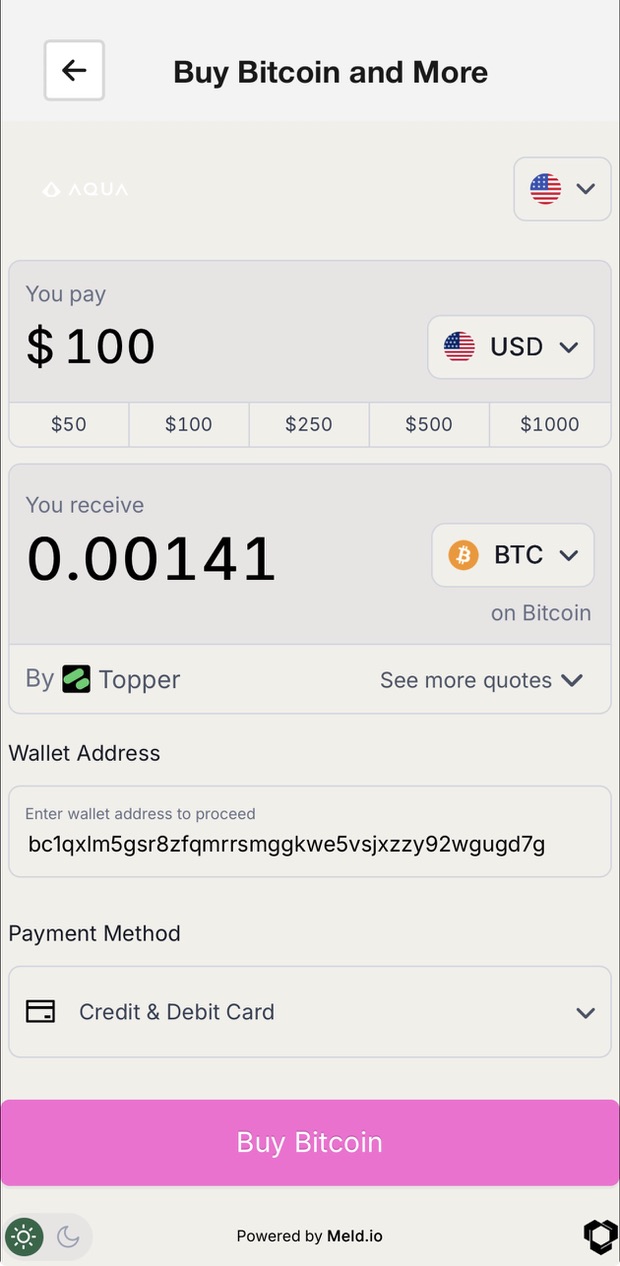
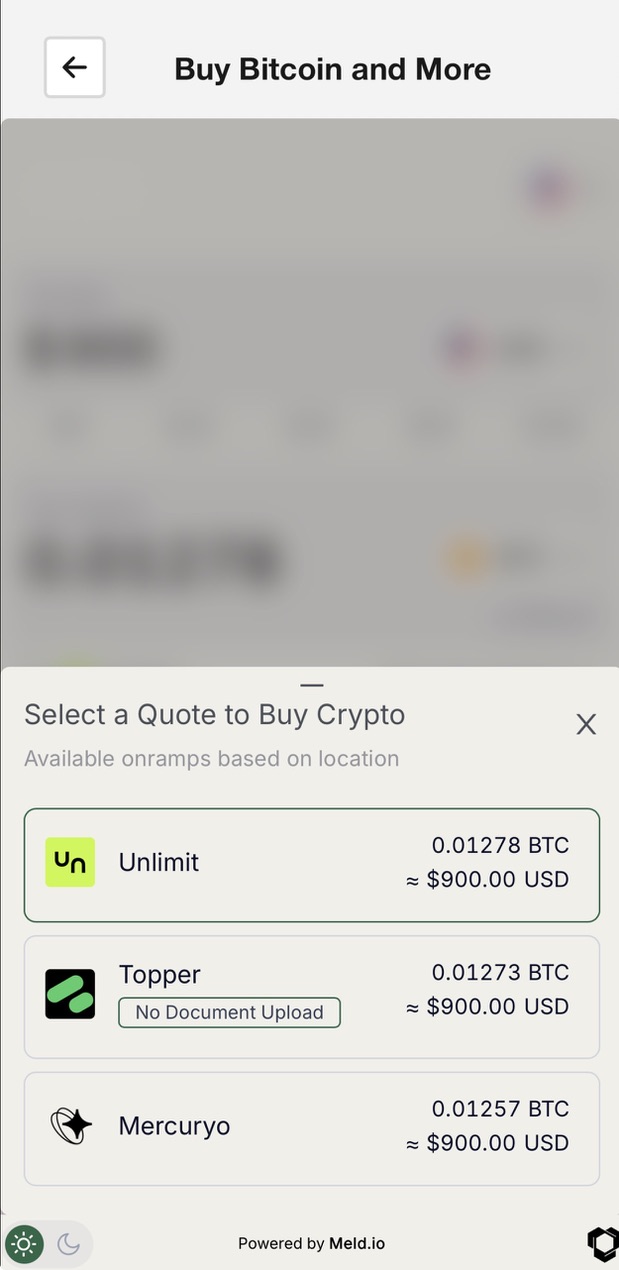
The juicy bit on how they accomplish this: AQUA integrates a Bitcoin on-ramp that lets users buy directly inside the app by creating a JAN3 account with nothing more than an email address. The process is powered by Meld and other providers including Topper, Unlimit, and Mercuryo, which handle the actual KYC/AML compliance. JAN3 holds Money Transmitter Licenses (MTLs) in all 50 U.S. states for facilitation purposes, while the on-ramp providers carry the regulatory burden for the actual purchase.
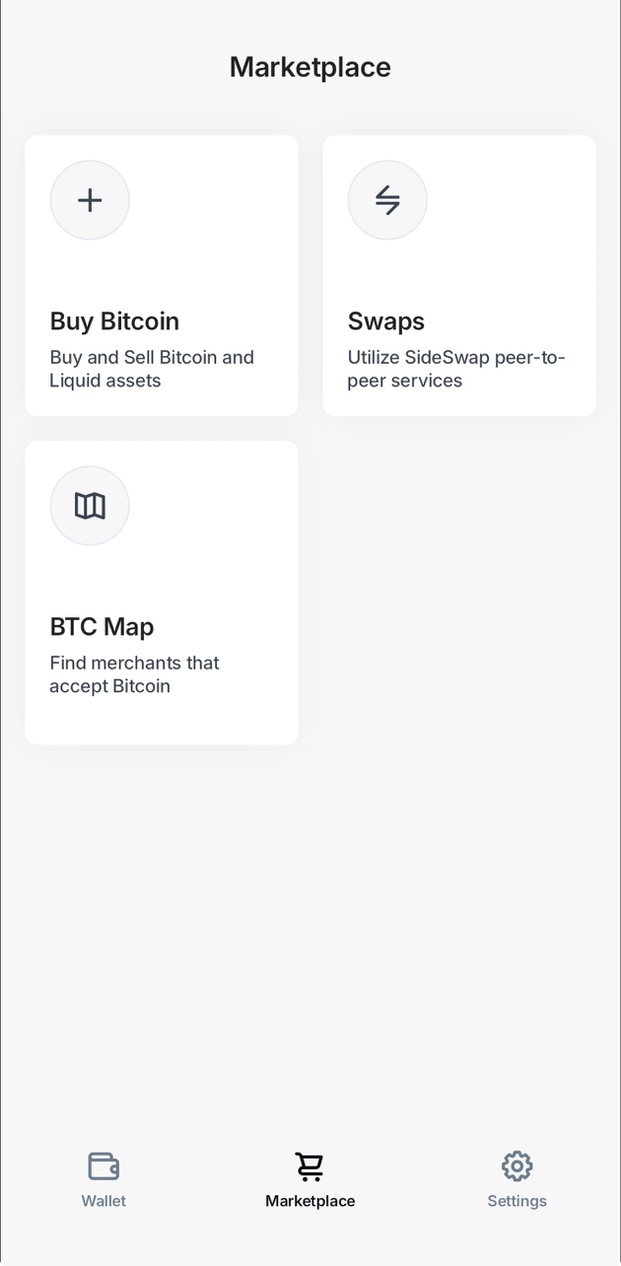
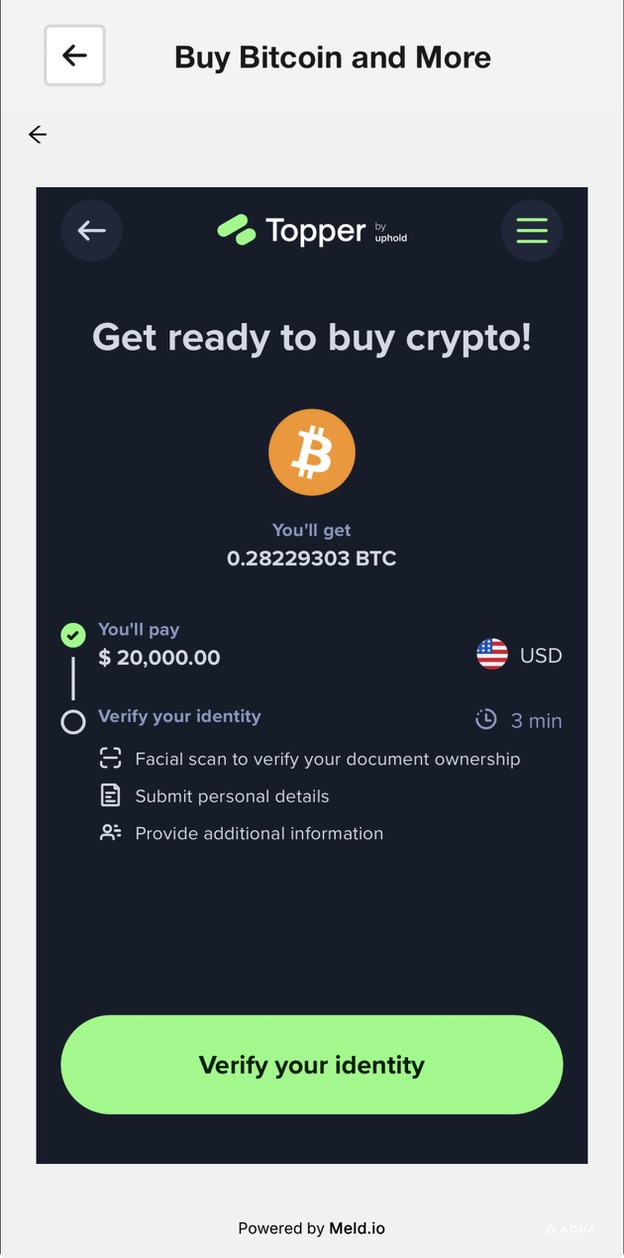
Here are some screenshots on how that looks in the UI flow. You see Meld's logo and select it and then you can see how that's handed off based on your amounts. Places like New York may have more stringent triggers (for KYC) than the southeast once you break $1,000, and as you surpass more thresholds between their three providers:

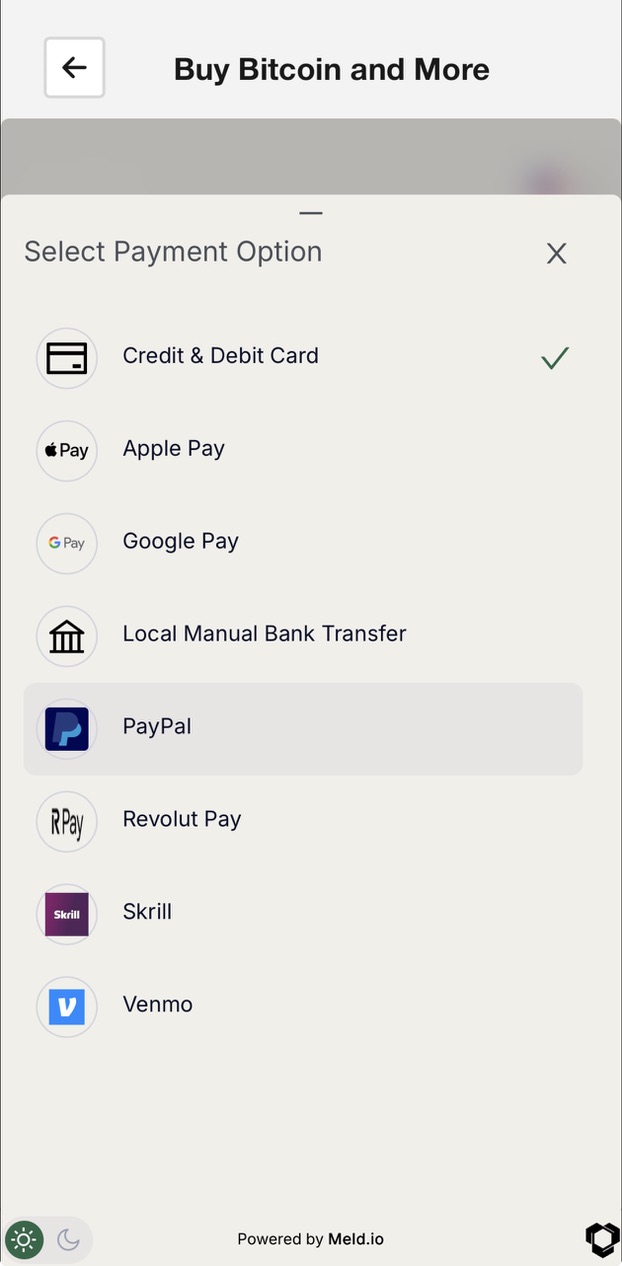
Supported payment methods include Apple Pay, PayPal, and several others as shown in screenshot:
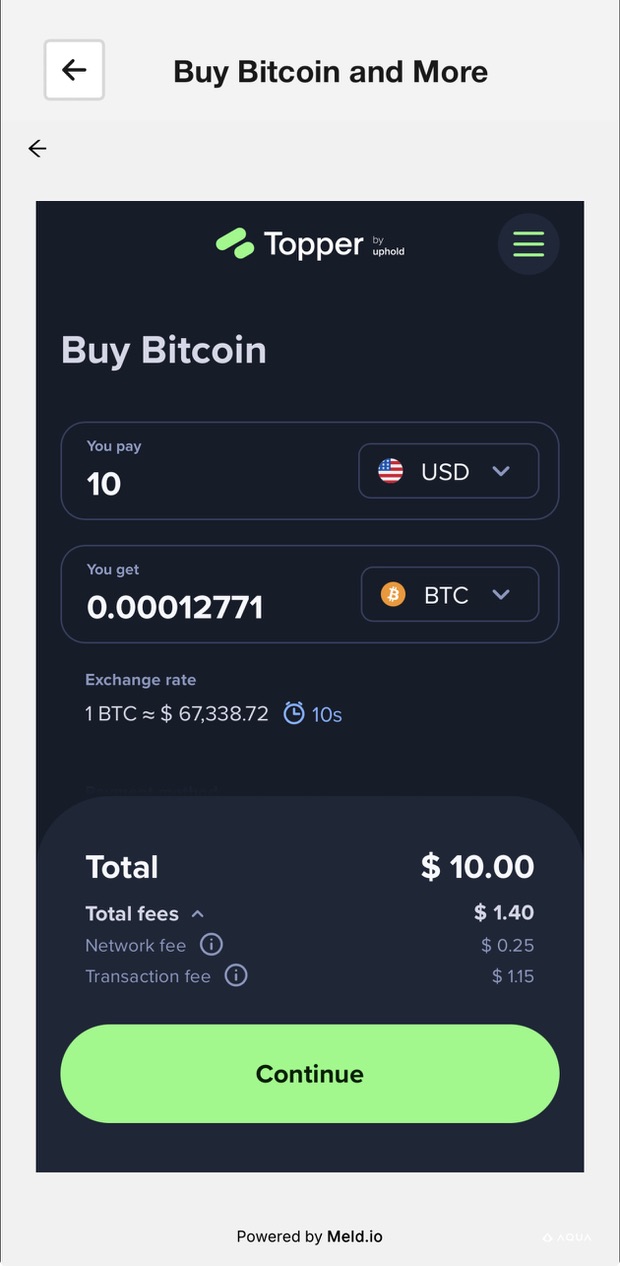
Fees are on the higher side, though the quoted spreads are competitive. I have double checked the fees after the threshold that triggers KYC, but it seems like you get a quote only for a minimum of a $6 Bitcoin Buy. Then, with the threshold you have to set it to about $8-9 and can make that purchase (or $10). So it adds about $2 in fees until you up the threshold to something like... $20,000.
How much can you buy without triggering KYC?
In most states, users aren't prompted for additional verification until purchases approach certain thresholds, in some states as low as $900. Depending on what state you are in, some of the KYC may trigger at different amounts… After $1,000, all providers appear to require further verification, some kicking in at around $900 between the three providers you may choose, and again at $10,000 to $20,000. Full KYC kicks in universally at that point as you can see below in more screenshots…
It's worth being clear: attempting to work around these thresholds using multiple email addresses or accounts is both illegal and increasingly detectable (as surprising to some in the legacy world as it is, they remain compliant with advanced AML/fraud detection with all the information they have access to... i.e. the device you're connecting from, payment method, IP, associates with other fraud pools, and several other types of risk profiles). Providers like Meld operate shared fraud pools built on email, IP address, device fingerprinting, location data, and payment method identifiers. Their teams have detections and work on these full-time. The compliance infrastructure is more sophisticated than it might appear on the surface and thus have been able to thus far provide this amenity…
Stablecoins, Direct Peg, and the Liquid Network
AQUA also supports a range of stablecoins and includes a feature called Direct Peg in the advanced settings. For users who want to bridge between platforms like Magic Eden or other Web3 ecosystems, the stablecoin support is there. Though, from a pure Bitcoin perspective, it may feel like noise.
For those who prioritize a simpler stack, these features are easy to ignore. They're opt-in additions, not front-and-center clutter, and good to have to bridge new features that make transacting more accessible across consumer and enterprise levels, providing services and QoL things that are still absent in the legacy traditional finance world.
Bitcoin Chip: Physical Collectibles Meet the Wallet
Buried in AQUA's advanced settings is something genuinely novel: Bitcoin Chip. It opens the camera to scan what appears to be a physical collectible... described as similar in concept to the old "Casascius physical bitcoins," that can be loaded with Bitcoin or USDT. The chips can carry a face value, and unused chips may accumulate collectible value beyond that amount.
It's a niche feature, but it reflects the kind of thoughtful, community-oriented product design that runs through AQUA more broadly. We could see a lot more really cool things like this though, and maybe this gives you some ideas to ask your Openclaw to brainstorm one for your own business too, and be able to transact with lightning over Aqua with your customers…
The Bigger Picture: Self-Custody Without the Complexity
What AQUA is trying to do, and largely has succeeded at, is thread a difficult needle. By offloading regulatory compliance to licensed providers and Lightning complexity to Boltz, the team has kept the wallet genuinely self-custodial while removing most of the friction that stops new users from getting started.
Funds go directly to your wallet. JAN3 doesn't hold them. The on-ramp is handled by a licensed third party. The Lightning swaps are non-custodial at the protocol level. For a product that feels this approachable, that's a meaningful achievement.
Being able to also buy Bitcoin in the app as advertised as self-custodial, is a gamechanger. Only a few others like Blockstream still offer similar services not necessarily through a more established exchange.
For the power user who wants to connect their own node, run their own routing, or avoid third-party on-ramps entirely, AQUA isn't the right tool. However, that's not the goal here, it's to onboard the waiter you just spoke to, to help them out, and to mass adopt everyone to the better technology (as BTCSessions has so gracefully described using Wallet of Satoshi in the field, since it's just so easy to grasp and use right away). One last point: some people may still see Cash App as a neo-bank, a prepaid card or look down on it… such as those who sip on cosmopolitans and swipe their blue debit and credit cards for more plane miles than the Earth can rotate, orbit, and revolve around our galaxy... but for anyone who wants to stack sats easily with a wallet they may identify with and use with their business, and one with an increasing amount of users (as the millions with Square) the sentiment is clear that more ubiquity in selection is a win for humanity, it is interoperable for the ~1.2 billion unbanked adults and who do not have access to financial services as represented in our world. This is why I've been participating in the space, it's an economic fuel and it helps all developed or developing regions to transact (like when the internet was first adopted). What else is as pertinent than connectdness with this broad a positive impact, feel free to share your thoughts with me and engage/reply.
For people who want to use Lightning without friction, and stay in control of their keys, AQUA is one of the more serious options available right now (there's also a cute dolphin), and it's one of the highest-grade UIs that is also approachable for the masses.
Download Aqua today via the Apple App Store or for Google Play Store via their website and
Learn more at aqua.net